

Feeding the Machine: Can AI Earn the Energy It Consumes?
The AI boom is already reshaping everything from logistics to legislation, but it’s energy-hungry. Can we balance its footprint by aiming it at big wins for the planet?

The other night over tacos, a few of us were musing about the implications of the massive energy demands of AI.
How on earth we will ever be able to stay ahead of it?
We sat there staring into our tortillas, realizing just how little transparency there is around the energy use of tools we rely on daily, like Photoshop, a Google Search, notetakers, custom apps, email search functions, and background processes we didn’t even authorize.
It’s everywhere all at once.
Most people don’t know how many watts they’re burning just scrolling through a casual news feed.
I certainly don’t.
But with all this talk about AI transforming the world, I started wondering: how do we tip the scale, so it’s at least transforming it in the right direction?
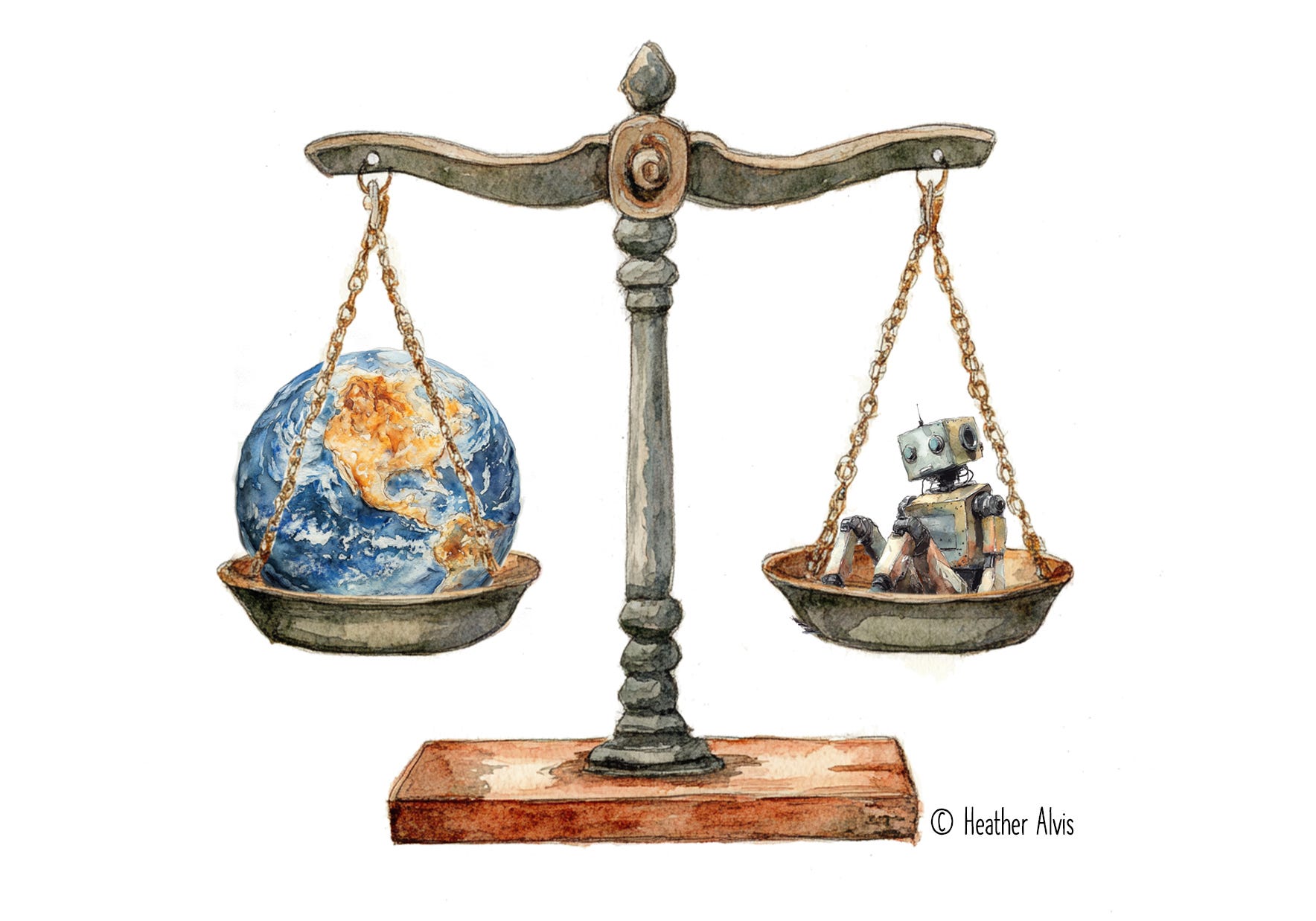
Because there’s no getting around the fact that AI is energy-intensive.
The data centers powering it are multiplying like mushrooms after rain. According to the IEA, electricity use from data centers (AI included) is set to double in just two years, reaching 1,000 terawatt-hours by 2026, nearly as much as the entire consumption of Japan.
UCSB researchers estimate that if AI model growth continues unchecked, it could consume as much as 20% of the world’s electricity by 2030.
That’s not theoretical.
That’s lights-off levels of energy demand.
But still, can we use AI to make the whole system smarter?
To reduce emissions somewhere else?
To make circularity...actually circular?
These are all messy and urgent matters that could use the help of some intelligent robots, right?
What would it take to tilt the balance?
The Good News is, GREAT things ARE happening with AI.
Waste Sorting & Reduction
Waste Sorting & Reduction
AI can sort recyclables from mixed bins more accurately than humans ever could.
Companies like Waste Robotics and AMP allow more cities to move to single-stream recycling and increase capture rates while maintaining quality.Predictive Maintenance for Infrastructure
AI models help predict when equipment (like wind turbines or HVAC systems) will fail, or need to be cleaned, allowing for maintenance before major breakdowns. This extends asset life, reduces resource waste, and avoids emergency emissions from backup systems.Land Use & Forest Monitoring
Tools like Global Forest Watch use satellite imagery and AI to detect deforestation in real time, enabling faster intervention and more targeted conservation efforts.
Energy Distribution Gatekeeper
Last week, Spain and Portugal went dark. A major blackout swept across the Iberian Peninsula, knocking out power for up to ten hours in some areas.
The culprit? Likely a failure in the control systems that manage energy distribution. Not a shortage of power, because there was plenty of that, but a glitch in the computers tasked with deciding where it should go, and when.
It’s an unsettling reminder that the more we digitize our grids, the more vulnerable they become to system-wide hiccups. And yet, the reality is that AI is already being placed at the helm of energy distribution.
Not someday. Now.
More than 200 companies have entered the “smart grid + AI” space over the past decade, with an average of a dozen new startups launching each year. With the recent acceleration in AI adoption and electrification, that number is poised to spike.
These aren’t niche players—they’re vying to control everything from real-time grid optimization to predictive maintenance, outage detection, demand response, energy arbitrage, and beyond.
AI isn’t just analyzing power grids anymore. It is the power grid.
The gatekeeper.
That means our clean energy future—solar, wind, nuclear, geothermal—will increasingly flow through an invisible layer of software. One we don’t fully understand. One that consumes its own share of electricity. One that, like the blackout in Iberia, can fail in ways we’re not always prepared for.
It’s hard to know how to feel about that.
Are we building resilience? I think so; we have to.
Are we stacking complexity? Yes, exponentially—like all the legos ever, stacked.
Is AI our best bet for balancing a renewable-powered grid responsibly?
Or are we quietly turning over the reins to a system that’s only as smart as the people training it?
And all of this is being designed by the people making money from it, of course.
Which isn’t you and me.
There’s something unsettling about that.
And something inevitable.
Can we put AI on an Energy Diet?
Some AI models, like DeepSeek, promise much lower energy consumption compared to mainstream tools. DeepSeek reportedly consumes a fraction of the energy and water required by larger models by using more compact datasets and optimized training methods.
Others focus on running on carbon-free power or designing models with energy efficiency in mind—a movement sometimes referred to as “Green AI.” It’s less flashy, more intentional. But in a world where every watt counts, that restraint might be exactly what we need.
Even Me. I use AI Every Day.
I’ve envisioned machine learning used to track solar panel recovery (with Electra), optimize truck routing for reuse logistics, and help us make smarter, leaner choices with fewer emissions. I even wrote about this in another post: how AI could help climate entrepreneurs stay focused, automate low-impact tasks, and free up more space for strategic thinking.
And I believe in that.
But I’d be lying if I said I knew what it costs.
I don’t know how much energy my prompts consume, or how clean the servers are behind the tools I use daily—note summarizers, data visualizations, search plugins, image idea generators, scheduling optimizers.
I talk about circularity, conservation, and climate... while quietly using systems that might be fueling the opposite.
It’s a strange feeling, doing the “right thing” with a blindfold on.
So the tools are evolving.
And in many ways, they’re cleaner than the alternatives.
After all, a virtual photoshoot powered by AI doesn’t require international flights, hotel rooms, rented gear, electricity for the studio, or a craft services table. It doesn’t generate wardrobe waste or post-production shipping emissions.
In some cases, using AI might be the lower-impact option.
That is my ultimate hope, at least.
And yet.
We’re living through an energy shift that we can’t see.
We don’t know how much our curiosity, productivity and boredom is costing.
We toggle on ChatGPT, run an AI image generator, and assume the price is baked in. But what if it isn’t? A $6 sweater has hidden costs, so why wouldn’t AI?
What if every prompt carried a kilowatt meter, like a gas tank?
Full throttle, or just the plain answer - you pay for what you choose.
What if we knew how much carbon our midnight chats with “Sol” added to the grid?
Would we still want to know every detail about every single thing?
Would we still ask it to rephrase our email and summarize our phone calls?
Would we keep scrolling?
Yes, we would.
There’s no clean answer.
Just a tangle of modern tradeoffs moving so fast we can’t fathom what’s happening.
When today’s new thing is tomorrow’s old news.
Maybe AI helps us see the problem more clearly.
Maybe it blinds us to it.
Maybe it gives us better tools.
Maybe it will become the future’s biggest headache.
Maybe it will bring peace on earth.
It’s like fast fashion: absurd in scale, but so surprisingly efficient that we can’t live without it.
I don’t think the solution is to turn everything off.
But I do think we need more transparency.
Because there’s a line between using a tool and being a tool.
And right now, most of us don’t know which side we’re on.